
EDP turns operational data into advanced modeling with PVRADAR
From years of data to site-specific soiling modeling
With more than 50 years of experience and over 5.5 GW of installed solar capacity across Europe, the Americas, and Asia-Pacific, EDP is a global renewable energy leader. Over time, EDP has built strong internal expertise and valuable data assets, creating a solid competitive advantage.
In 2025, EDP partnered with PVRADAR with a clear goal: to develop proprietary site-specific soiling models leveraging on its own data and a soiling database provided by PVRADAR. The PVRADAR software development kit (SDK) helps EDP structure, format, and use its data within a single modeling framework: combining automated access to data sources, multiple models from the literature, and a set of built-in analytical functions.


Marta Díaz Cosmen
Associate Director, PV & Hybrid Systems Energy Assessment

Leveraging internal and PVRADAR soiling data with PVRADAR SDK to enhance proprietary models
EDP closely monitors soiling conditions across its operative solar portfolio using a network of installed and maintained soiling sensors. To apply this knowledge to new projects, EDP aims to develop models based on their experience, reducing uncertainty early in the project lifecycle.
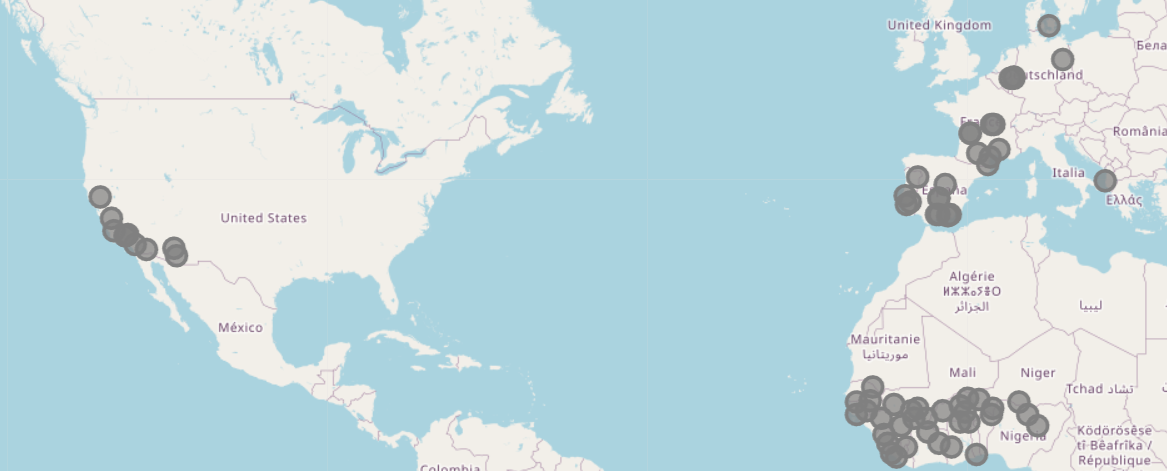 Extract of soiling measurements shared by PVRADAR with EDP’s Measurement DB. The dataset is further enriched with EDP’s internal measurements, providing a standardized reference for data visualization, analysis, and model validation.
PVRADAR made all soiling measurements available through a private measurement database, ensuring the data is structured, standardized, and ready to use. This means that any soiling measurement is instantly available for further visualization, analysis or as reference for model validation in a single line of code in a Jupyter notebook.
In addition, PVRADAR also added 50 additional soiling datasets from locations worldwide. These datasets enable EDP to refine site-specific models, allowing teams to anticipate soiling behavior at new sites and assess soiling risk over the project’s lifetime.
Marcos Ruiz Escudero
PV, Hybrid and Storage Associate
PVRADAR brings advanced modeling into project development
The PVRADAR SDK allows EDP to quickly calibrate models, run them for any location globally in a single line of code and use measured data to optimize input parameters.
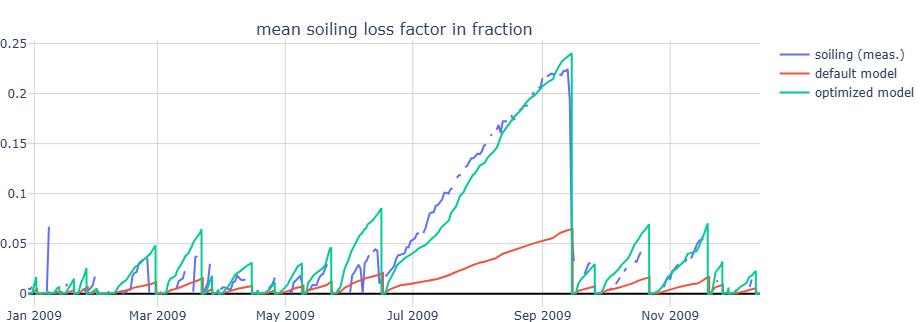 Example of site-specific soiling modeling. The figure compares measured soiling at the site (blue), estimates from the default pvlib HSU model (red), and results from the fine-tuned model calibrated using the reference data (green).
Once site-specific models are developed, they can be easily shared across the organization, allowing all development teams to benefit when evaluating new projects. This means that EDP engineers and project developers can assess soiling risk for any location worldwide in just minutes, using a streamlined and transparent workflow.
Using PVRADAR’s web-application users can also evaluate different cleaning strategies, compare multiple cleaning technologies, and analyze the economic impact of different cleaning schedules.
Beyond soiling. A framework for modeling without limits.
While the initial focus of the collaboration was soiling, the underlying framework extends far beyond a single loss mechanism. PVRADAR is designed as a general-purpose modeling environment that allows engineering teams to address a wide range of PV-related questions using the same data-driven workflow.
By standardizing how data, models, and validation are handled, PVRADAR enables organizations like EDP to progressively build a library of internal models that reflect their operational experience and tackles a wide range of modeling challenges: environmental losses, BESS, design optimization and more.

Thore Müller
CEO
Interested? Contact us.
Turn your data into better decisions.
Contact us to see how PVRADAR can help you unlock its full value.